 English
 Russian
 French
 Spanish
 Portuguese
 Arabic
 Vietnamese
 Turkish
Mining
A high-tech enterprise focusing on the development and application of X-ray technology products, committed to becoming a leading supplier of X-ray industrial testing solutions.
5 Key Factors to Consider When Choosing an XRF Mineral Analyzer for Your Operation
Investing in an XRF (X-Ray Fluorescence) mineral analyzer is a significant decision for any mining, exploration, or processing operation. The right instrument can dramatically improve efficiency, reduce costs, and enhance decision-making. But with various models, features, and price points on the market, how do you choose the one that’s truly right for your specific needs?
Selecting the wrong analyzer can lead to inaccurate data, operational bottlenecks, and a poor return on investment. To help you navigate this critical purchase, we’ve outlined the five key factors you must consider before making your choice.
1. Application & Material Type: Define Your Primary Need
The most important question is: What will you be analyzing?
Exploration & Grade Control: For field exploration, soil analysis, and quick core logging, you need robust detection limits for light elements (like Mg, Al, Si) and pathfinders.
Mine Production & Stockpile Management: Here, speed and precision for your specific ore body (e.g., Cu, Zn, Fe, Au in concentrate) are paramount to ensure blending and meet shipment specifications.
Environmental & Regulatory Testing: This often requires stringent, laboratory-grade accuracy and the ability to detect trace levels of hazardous elements (e.g., As, Pb, Hg).
Alloy & Scrap Identification: While less common in primary mining, this is crucial for processing or recycling operations, requiring excellent performance for a wide range of metal alloys.
Action Point: Create a clear list of the primary elements you need to measure and their expected concentration ranges (from trace to percent levels).
2. Portability vs. Benchtop: Where is Your Analysis Point?
This decision fundamentally shapes your workflow.
Portable/HANDHELD (pXRF): Offers unparalleled flexibility for in-situ analysis. Take the lab to the sample—at the outcrop, on the drill rig, by the conveyor belt, or in the stockpile. Modern pXRF analyzers are rugged, offer GPS/GIS integration, and provide excellent data for rapid decision-making. Compromises can sometimes be made on ultimate sensitivity for light elements compared to high-powered benchtops.
Benchtop/Laboratory: Provides the highest levels of precision, accuracy, and detection limits, especially for lighter elements. They are ideal for processing prepared samples (pulps, powders, pressed pellets) in a controlled environment, generating final assay-grade data for resource reporting. They require sample preparation and a fixed location.
Action Point: Assess your workflow. Do you need real-time, location-specific data (choose portable) or the highest possible analytical quality for prepared samples (choose benchtop)? For many operations, a combination of both is the ultimate solution.
3. Performance Specifications: Look Beyond the Brochure
Don’t just glance at the specs—understand what they mean for your work.
Detection Limits: How low can it reliably measure? A "ppm-level" claim is vague. Ask for specific detection limit sheets for the key elements in your matrix.
Light Element Performance: Analyzing minerals with Mg, Al, Si, P, S? This requires a high-performance detector (like a large-area SDD) and often a vacuum or helium purge. Not all analyzers handle light elements equally well.
Accuracy & Precision: Request test reports or conduct a demo with your own samples. The best spec sheet is irrelevant if the analyzer can’t deliver consistent, accurate results on your material.
Throughput & Speed: How many seconds per reading do you need to maintain workflow? Faster analysis often means more data points, but may trade off some precision.
Action Point: Always conduct a hands-on demonstration with your actual samples to validate manufacturer claims.
4. Ruggedness, Environment & Compliance
An analyzer is a tool that must survive your operational reality.
IP Rating: For portable units, look for a high Ingress Protection (IP) rating (e.g., IP54 or better) for dust and water resistance.
MIL-STD Drop Test: Ensures the device can withstand accidental drops—a common occurrence in the field.
Temperature & Humidity Range: Ensure it operates in the climate conditions of your site, from desert heat to arctic cold.
Radiation Safety & Licensing: All XRF devices are regulated. Understand the licensing requirements in your country/region. Modern pXRF analyzers have excellent safety interlocks, but compliance is mandatory.
Action Point: Match the instrument’s ruggedness specifications to your harshest expected working conditions.
5. Total Cost of Ownership (TCO) & Support
The purchase price is just the beginning. Consider the long-term investment.
Calibration & Maintenance: What is the cost and frequency of factory calibration? How easy is it to clean or replace the probe window or shutter?
Battery Life & Workflow: For portable units, battery life dictates field shift duration. Do you need hot-swappable batteries?
Software & Data Management: Is the software intuitive? Can it easily export data to your geological modeling or LIMS software? Are there ongoing license fees?
Training & Technical Support: What level of training is provided? Is local, responsive technical support available for repairs and troubleshooting? A machine is only as good as the support behind it.
EulerX 500 is a fast, accurate, and durable handheld XRF analyzer for mining, exploration, and geoscience applications. Utilizing XRF technology with an SDD detector and FP method, it delivers lab-quality, on-site results in seconds with minimal sample preparation. Capable of analyzing 43 elements simultaneously—including rare earths and key oxides—it features an ergonomic design, a 5-inch color touchscreen, and robust IP54-rated protection for harsh environments. With WiFi/USB connectivity and Terras PC software for data control and reporting, the EulerX 500 enhances discovery rates, operational efficiency, and decision-making in the field.
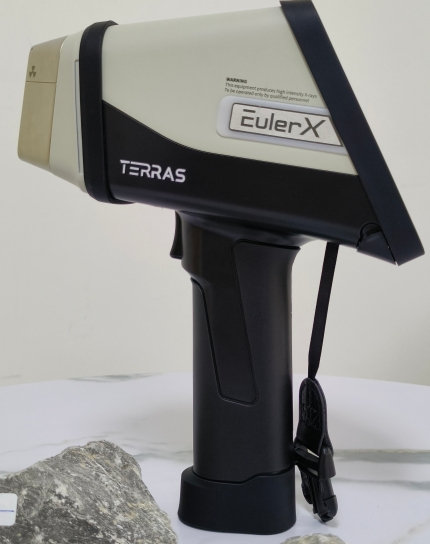
Terras EulerX500 Handheld Mining Analyzer
Making the Final Decision
Choosing the right XRF mineral analyzer is a strategic investment. By systematically evaluating these five factors—Application, Form Factor, Performance, Ruggedness, and Total Cost of Ownership—you move beyond marketing claims to find the tool that truly fits your operational puzzle.
The ultimate step is to engage with reputable manufacturers, ask pointed questions, and test the instruments with your own samples on your site. The data you trust will be the foundation of your most critical decisions—choose the analyzer that earns that trust.
About Terra Scientific
Terra Scientific is a high-tech manufacturer specializing in the development and application of X-ray technology products. We are committed to becoming a world-class provider of X-ray industrial inspection solutions. Terra Scientific currently offers a range of products to global customers, including handheld alloy analyzer, handheld precious metal analyzer, handheld mining analyzer, benchtop precious metal analyzers, in-line analyzer, and spectrometer modules, along with XRF analyzers. We continuously serve global clients in fields such as mechanical manufacturing, metal processing, aerospace, petrochemicals, mining and geology, food safety, environmental protection, and scientific research.
To learn more, please don't hesitate to contact us via email at sales@terra-scientific.com, or visit our website at http://www.terra-scientific.com
Join Us
Subscribe to our email list for updates & promotions.